When a Pedal Beats a Bot: The Real Risk Zone in Partial Automation
When a Pedal Beats a Bot: The Real Risk Zone in Partial Automation
An NTSB preliminary finding that a Tesla driver floored the accelerator while FSD was engaged cuts through the culture-war haze to a simpler truth: the human can still overrule the machine, and the hard problem is how the interface handles that moment.
 Theo AnandTechnology Columnist
What the report actually says
The National Transportation Safety Board released a preliminary report on a Texas crash that killed a 76-year-old resident, and its core finding is unambiguous. Full Self Driving was engaged, and electronic data showed the driver manually overrode it by pressing the accelerator to 100 percent. Ars Technica reports that the NTSB has not yet determined the cause of the crash and is continuing to investigate. That means we have evidence of what the driver did, and clarity that this evidence does not resolve the larger why.
Ars Technica notes that this finding aligns with public statements from Elon Musk and Tesla executive Ashok Elluswamy, who said internal data showed the accelerator was pressed all the way in a residential area. The article also reports that security camera footage showed the car continue straight through an intersection, leave the roadway, and strike a home. Local reporting cited by Ars Technica describes speed exceeding 70 miles per hour in the six seconds before impact.
"The driver manually overrode FSD (Supervised) by pressing the accelerator pedal to 100 percent."
The NTSB phrasing matters. It establishes that the system was active, and that a human input took precedence. It does not certify the safety of any product, and it does not assign fault. It identifies a specific input path that ended with tragedy, and leaves open the technical and human context around that input.
What the report does not say
The preliminary report does not determine the probable cause of the crash. It does not say why the driver pressed the accelerator. It does not evaluate whether FSD behavior before the override contributed to the outcome. It does not weigh the plausibility of other theories beyond recording the data it has. Ars Technica reports that the investigation remains open, and that the National Highway Traffic Safety Administration has opened a special investigation as well.
Ars Technica also describes parallel legal steps. The driver has been charged with manslaughter, and the family has sued both the driver and Tesla, alleging negligence and raising a sudden unintended acceleration theory. Police initially found no mechanical malfunction, according to the report. None of this changes the NTSB posture. The board is still gathering facts, and its role here is to issue safety recommendations after determining probable cause.
The simple truth in the data
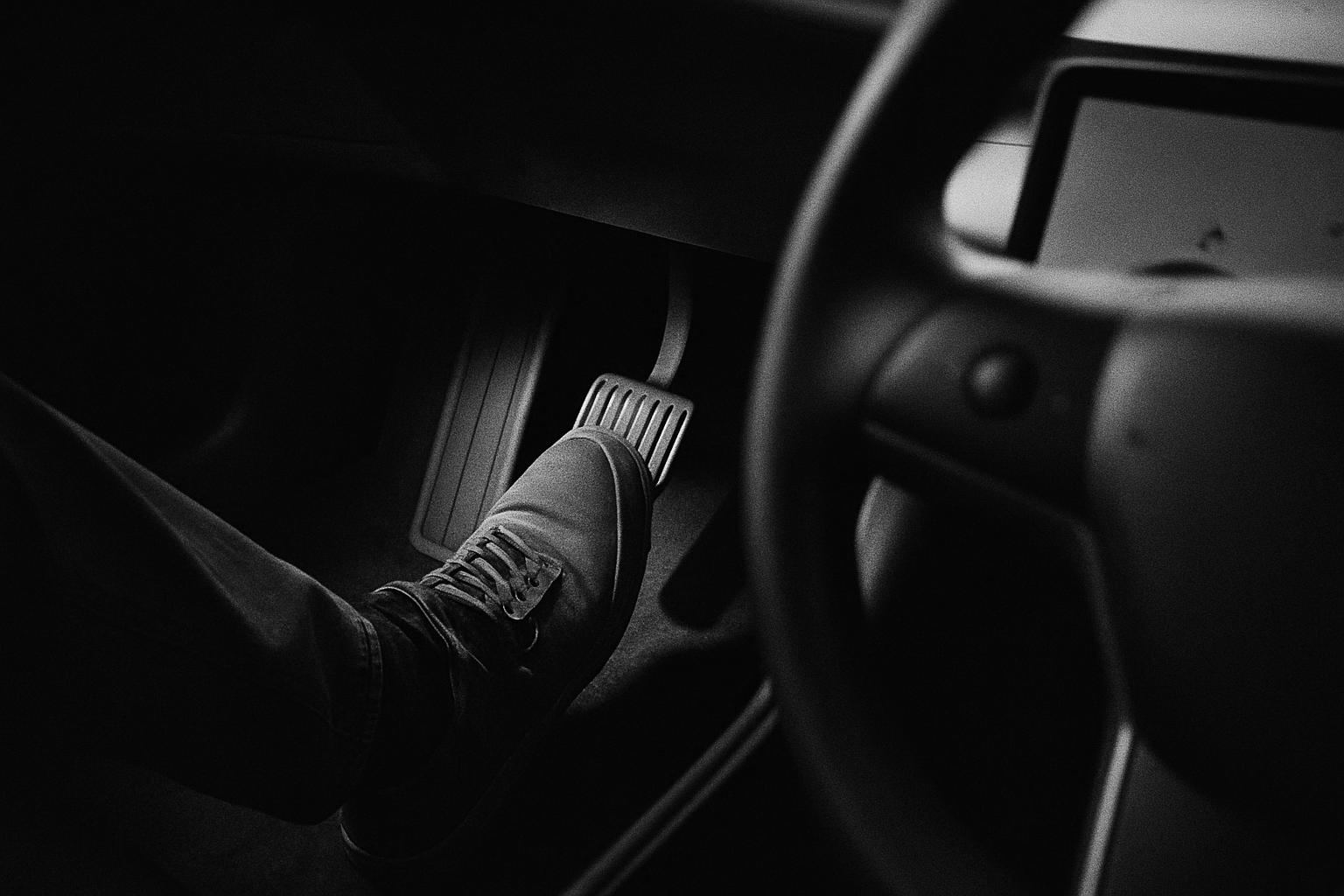
Set aside the slogans for or against automation. The report points to something simpler. In this case, the accelerator won. The machine was active, the human asked for maximum power, and the car delivered speed and a straight line that ended in a house. That priority ordering is explicit in the NTSB language that the driver manually overrode FSD by pressing the pedal to 100 percent.
If you design a system that allows supervised automation, you have to choose what happens when human and machine disagree. In this event, the system favored the human pedal command. The logic is intuitive. A driver might need instant power to avoid a hazard. The cost is equally obvious. A mistaken command at the worst possible time is amplified by the speed and mass of the vehicle.
The interface risk zone
Partial automation creates an interface where attention, intent, and control can drift. The NTSB report situates this crash inside that zone. FSD was engaged, then the driver input arrived, then speed built rapidly, then impact followed. We do not know the driver’s state of mind, and we do not know whether the system behavior before the override influenced that decision. We only know the sequence Ars Technica relays from the NTSB and from local reporting cited by Ars Technica.
This is where product decisions matter. How strongly should a system resist an accelerator input that conflicts with map context or recent path planning. How much mediation, if any, should occur in a residential area when speed spikes. When the driver asks for 100 percent, what responsibility does the software retain to sanity check that request against the surroundings that its sensors and maps perceive. The NTSB report does not answer these questions. It makes them unavoidable.
What logs can tell, and what they cannot
Ars Technica reports that Tesla provided internal data that was consistent with the NTSB finding of a manual override through the accelerator. Data logs can show timing, magnitude, and mode. They can rule in a command, like a fully depressed pedal. They cannot, on their own, tell you whether an interface nudged a driver to make that command, or whether the driver trusted the system in a way the designers did not intend. That is the gap between telemetry and human factors that often decides real outcomes.
Designing for worst case human inputs
This case suggests a design test that reads like a blunt instrument. Assume the worst input arrives at the worst time, then decide how the software arbitrates. If the answer is that the human always wins instantly, then the system should aggressively gate where automation can be used, or constrain how much power can be added in sensitive contexts while still allowing emergency maneuvers. If the answer is that the software sometimes slows or rejects a command, then the interface must teach that limit clearly, because surprise is its own hazard.
The NTSB is careful in its language, and Ars Technica is careful in presenting it. The investigation is ongoing. What we have now is a clean statement that a human override preceded a fatal impact while FSD was engaged. That is not a verdict on automation. It is a reminder that the boundary between human and machine is a product surface like any other. Ignore the slogans. Read the interface.